
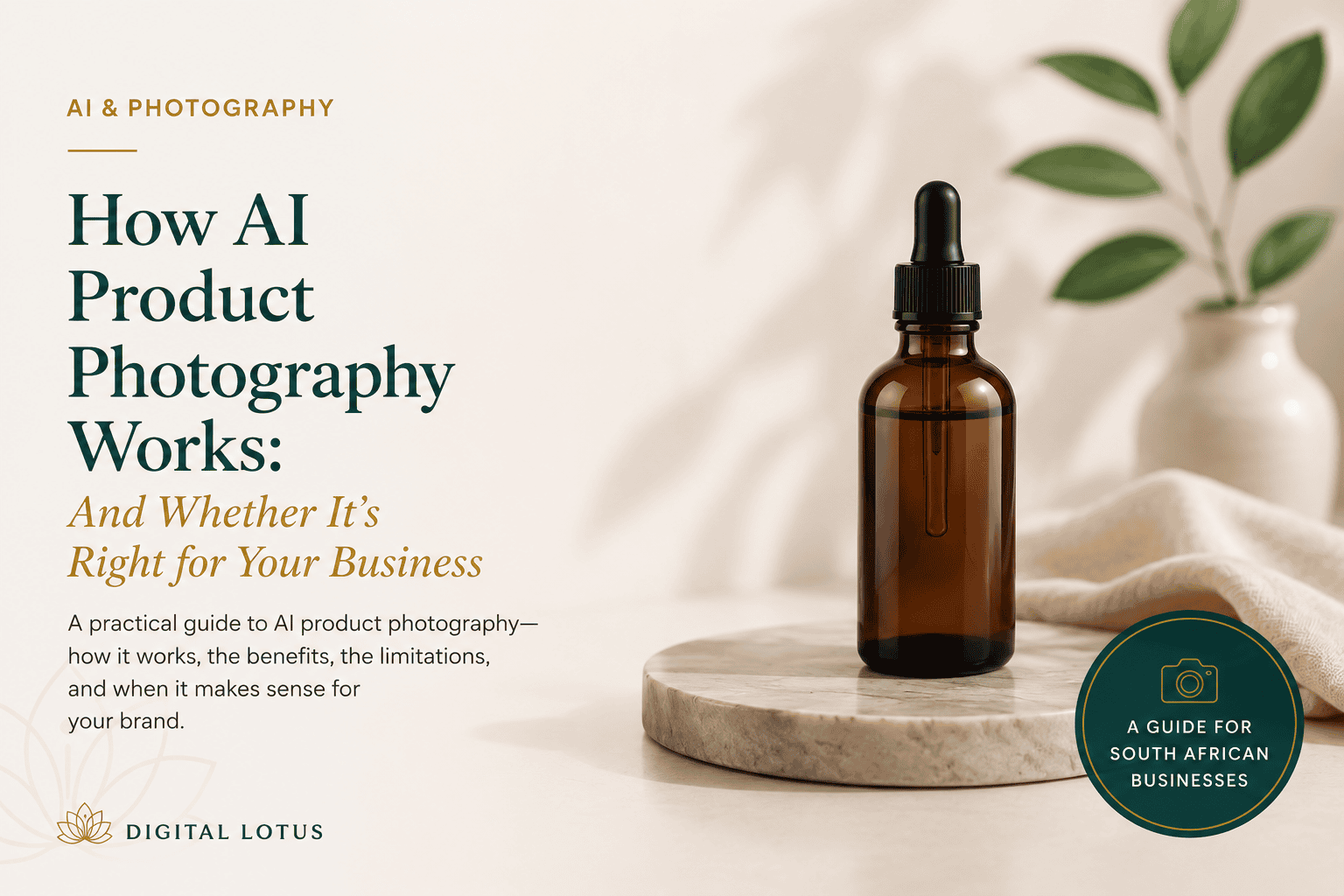
Good product photography has always carried a slightly frustrating truth: the images that look effortless are usually anything but.
There is the product itself, the lighting, the styling, the location, the photographer, the editing and sometimes a reshoot because one small detail was not quite right.
AI product photography has changed that process. It can place an existing product image into a new scene, create campaign variations and help smaller businesses produce polished visual content without organising a full shoot every time.
But it is not magic, and it is not the right answer for every product.
The best use of AI is not to replace good creative thinking. It is to make more of that thinking possible within the time and budget available.
What is AI product photography?
AI product photography uses generative image technology to create or alter the environment around a product.
You may begin with a clean photograph of a candle, skincare bottle, piece of jewellery or packaged product. The product is then placed into a newly generated setting; a bathroom shelf, a botanical scene, a studio backdrop or a lifestyle environment.
The aim is usually not to invent a different product. It is to present the real product in a wider range of visual settings.
How the process actually works
Start with the strongest possible source image
AI works best when it is given a clear, well-lit image of the real product. The label should be readable, the shape should be accurate and important details should not be hidden.
A quick phone photograph can sometimes work, but the quality of the source image still places a ceiling on the final result.
Decide what the image needs to communicate
A useful brief is more than “make it look luxurious.” Luxury can mean polished marble, dark editorial lighting, sunlit linen or quiet minimalism.
The visual direction should come from the brand and the intended use of the image. A website banner, product listing and Instagram campaign may each require a different composition.
Generate and refine the setting
The product may be isolated from its original background and introduced into a generated scene. Several versions are usually explored before one feels believable and aligned with the brand.
This is where careful art direction matters. The lighting, scale, shadows, reflections and perspective all need to agree with one another.
Retouch the details
AI-generated images often need manual refinement. Labels may distort, edges may soften and reflections may behave strangely.
The strongest results are normally a combination of AI generation, design judgement and traditional editing rather than a single click.
Where AI product photography works particularly well
- Creating atmospheric website banners and campaign images
- Producing seasonal variations without rebuilding an entire set
- Testing different creative directions before a physical shoot
- Giving small product ranges more visual variety
- Creating supporting lifestyle imagery for social media
- Extending the use of existing product photographs
It can be especially useful for small businesses that need professional-looking campaign content but cannot justify a styled shoot every few weeks.
What it does not replace
AI is not always suitable for the main product image on an online shop. Customers need to see the item accurately, especially when colour, scale, texture or fit affects the buying decision.
It also struggles when a product contains intricate typography, transparent packaging, complex reflections or very specific physical details.
For fashion, food, people and products where exact representation is essential, traditional photography may remain the stronger foundation.
Can customers tell that an image was made with AI?
Sometimes.
People may not immediately identify the technology, but they often notice when something feels slightly wrong. A shadow falls in the wrong direction. A label has changed. The product appears to float. The setting feels far more expensive than the product presentation elsewhere.
The goal should not be to fool the viewer. It should be to create a believable, well-directed visual that supports the real product.
Brand consistency matters more than novelty
One of the easiest mistakes is generating a collection of individually beautiful images that do not feel connected to one another.
Your AI imagery should still follow the same visual world: similar lighting, colour mood, styling choices and level of detail.
Without that direction, the brand can begin to look like a collection of unrelated trends.
Just because an image can be created does not mean it belongs to the brand.
Questions to ask before using AI imagery
- Will the product remain accurate and recognisable?
- Does the setting suit the brand rather than simply following a trend?
- Where will the image be used?
- Does the image need to communicate exact scale, texture or colour?
- Will a customer feel misled when the real product arrives?
- Do we have a good source photograph to begin with?
- Can the final image be refined by someone with a design eye?
Is AI product photography cheaper?
It can be, particularly when the alternative involves location hire, props, styling and repeated shoots.
But “cheaper” should not be confused with “instant.” Producing a strong image still involves briefing, experimentation, selection and detailed retouching.
The real value is often flexibility. One source image can support several campaign directions, sizes or seasonal variations without starting the entire production process again.
So, is it right for your business?
AI product photography is worth exploring when you already have a clear product, a clear brand and a specific visual need.
It is less useful when the hope is that technology will compensate for poor product images, unclear branding or no creative direction.
Used thoughtfully, it can help a small business create richer visual campaigns and stretch the value of its existing photography. Used carelessly, it can make the product feel less trustworthy.
I see AI product photography as another tool in the creative process, not a replacement for photography, design or judgement.
The most convincing results still begin with a real product, a clear idea and someone paying attention to the details.
Curious about using AI imagery for your products?
Share the product images you already have and tell me where the new visuals need to be used. I can help you decide whether AI enhancement, traditional editing or a new shoot would make the most sense.
Start a conversation